Entry-Level Resume: Proven Format & Powerful Tips for Freshers
By CareersOz Editorial Team · Published · 16 min read
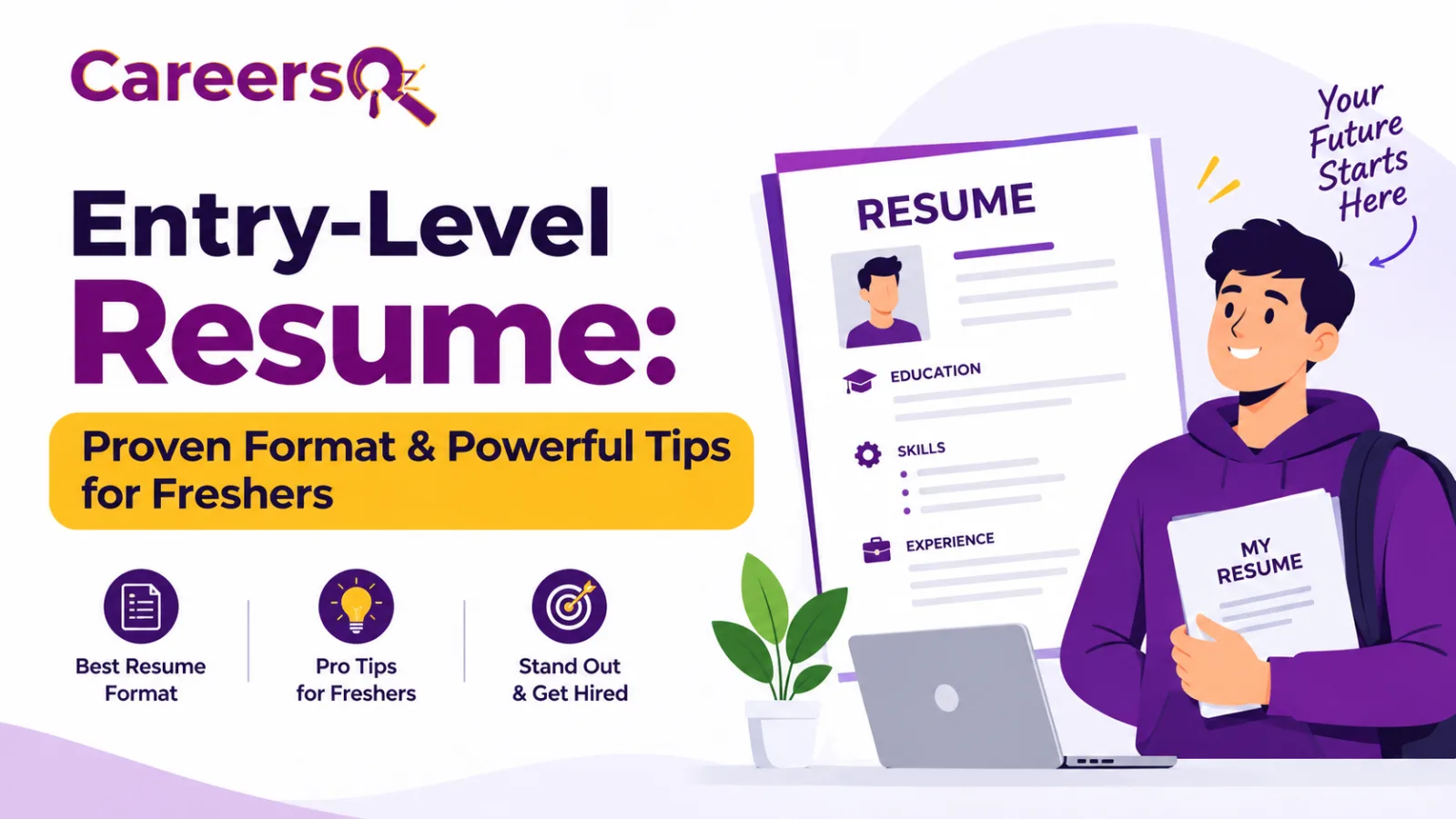
Starting your career can be challenging when most job descriptions seem to ask for experience. An entry-level resume helps you present your education, skills, internships, academic projects, certifications, achievements, and other relevant experience when you have limited or no full-time work history.
The good news is that you do not need years of professional experience to create a strong resume. You need to show employers what you can do, what you have learned, and how your background relates to the job you want.
Quick Answer: What Is an Entry-Level Resume?
An entry-level resume is a job resume designed for students, recent graduates, freshers, career starters, or candidates with limited professional experience. It focuses on relevant education, skills, internships, projects, certifications, achievements, and transferable experience rather than relying only on full-time employment.
For most entry-level applications, keep your resume concise, tailor it to the job description, use clear formatting, and include only information that helps demonstrate your suitability for the position.
What Is an Entry-Level Resume?
An entry-level resume is typically used when you are:
- Applying for your first full-time job
- A recent university or college graduate
- Still a student
- Looking for an internship
- Changing from education into employment
- Applying for a position where you have limited professional experience
- Returning to work with little relevant experience
Your resume does not have to look empty just because you have not held a full-time job.
For example, a fresh graduate might have:
- A university degree
- An internship
- Two academic projects
- A professional certification
- Technical skills
- Volunteer experience
- Leadership activities
- Freelance work
- Relevant coursework
All of these can help demonstrate relevant capabilities when presented honestly and clearly.
Entry-Level Resume vs. Regular Resume
The basic sections of a resume are similar at different career stages. The main difference is what receives the most attention.
| Entry-Level Resume | Experienced Resume |
|---|---|
| Education may receive more attention | Professional experience usually dominates |
| Skills are important | Skills support professional experience |
| Academic projects can be valuable | Work achievements are usually more important |
| Internships can demonstrate experience | Internships may become less prominent |
| Certifications can strengthen the profile | Certifications support career specialization |
| Volunteer/leadership experience may help | Usually included only when relevant |
The goal is not to make an entry-level resume look like a senior professional's resume. Instead, organize it around the strongest evidence you have.
Resume vs. CV: What's the Difference?
The terms CV and resume are often used interchangeably, especially in South Asian job markets.
A resume is generally a concise document tailored toward a specific job. An academic CV can be much more detailed and may include extensive academic achievements, research, publications, conferences, teaching experience, and other scholarly information.
For a typical private-sector entry-level job, a concise, relevant resume is usually more appropriate than submitting a long academic-style document.
If an employer specifically asks for a CV, follow the employer's instructions.
What Should an Entry-Level Resume Include?
A strong entry-level resume commonly includes:
- Contact information
- Professional summary or objective
- Education
- Skills
- Internship or work experience
- Academic or personal projects
- Certifications
- Achievements or relevant activities
You do not necessarily need every section. Choose sections that strengthen your application.
1. Contact Information
Place your basic contact information near the top.
Include:
- Full name
- Phone number
- Professional email address
- City and country
- LinkedIn profile, if relevant
- Portfolio or GitHub link, if relevant
Example
Muhammad Ahmed Lahore, Pakistan +92 XXX XXXXXXX muhammad.ahmed@email.com linkedin.com/in/muhammadahmed github.com/muhammadahmed
Avoid unnecessary information simply because it was traditionally included in some CV formats.
For example, do not add personal information that is unrelated to the job unless the employer or application specifically requires it.
2. Resume Summary or Objective
Freshers often ask whether they should use a resume objective or a professional summary.
Both can work, but they serve slightly different purposes.
Resume Objective
An objective focuses on:
- The type of position you want
- Your career direction
- What relevant skills you bring
Example
Recent BS Computer Science graduate with hands-on experience in Python, SQL, and academic software projects, seeking an entry-level software development position to apply programming and problem-solving skills.
Professional Summary
A summary focuses more on what you already bring to the employer.
Example
Recent BS Computer Science graduate with academic project experience in Python, SQL, and web application development. Strong foundation in programming, database concepts, and problem-solving, with experience collaborating on university projects.
Which Should a Fresher Choose?
If you have limited evidence to summarize, a concise objective can work well.
If you already have internships, projects, certifications, or relevant experience, a short professional summary can provide a stronger introduction.
Do not write a generic statement such as:
"I am a hardworking, motivated and passionate person looking for a challenging opportunity."
Replace vague claims with specific skills, qualifications, and career direction.
Best Entry-Level Resume Format for Freshers
There is no single format that works for every candidate. The right choice depends on your background.
| Resume Format | Best For | Advantage | Potential Problem |
|---|---|---|---|
| Reverse chronological | Candidates with relevant experience | Familiar and easy to scan | Limited experience may be less prominent |
| Skills-based | Candidates with very limited experience | Highlights relevant skills | Can make experience harder to evaluate |
| Combination | Candidates with skills plus some experience | Balances skills and experience | Requires careful organization |
Reverse-Chronological Format
This format places your most recent experience first.
It works well if you have:
- An internship
- Freelance work
- Relevant part-time work
- Recent practical experience
Skills-Based Format
This format puts more emphasis on capabilities than employment history.
It can help when you have little formal experience, but you should still provide evidence for your skills through projects, coursework, certifications, internships, or other relevant activities.
Combination Format
This combines skills with relevant experience.
It can be useful for a graduate who has:
- A degree
- Internship experience
- Projects
- Technical skills
- Certifications
For most fresh graduates with some practical experience, a simple and clearly organized structure is preferable to an overly designed resume.
How to Write an Entry-Level Resume With No Experience
Having no full-time job experience does not mean you have nothing to put on your resume.
Look for evidence of relevant skills in the following areas:
1. Internships
An internship can demonstrate practical exposure to a professional environment.
Instead of writing:
Worked as an intern at a company.
Show what you actually did.
Weak:
Helped with marketing tasks.
Better:
Assisted with keyword research and content optimization for website pages as part of a digital marketing internship.
Only include tasks you actually performed.
2. Academic Projects
University projects can demonstrate technical and professional skills.
For example:
Student Management System
- Developed a database-driven student management project using Python and SQL.
- Designed database tables and implemented basic CRUD functionality.
- Collaborated with three classmates to complete the project.
The project gives the employer evidence of skills even though it was not paid employment.
3. Personal Projects
Personal projects can be particularly useful for technology-related positions.
Examples include:
- Website development
- Mobile application
- Data analysis project
- GitHub project
- Marketing campaign
- Graphic design portfolio
- Automation project
4. Freelance Work
If you have completed genuine freelance work, include relevant projects.
For example:
Created and optimized WordPress websites for small-business clients.
Do not exaggerate the number of clients, revenue, results, or responsibilities.
5. Volunteer Experience
Relevant volunteer work can demonstrate:
- Communication
- Organization
- Leadership
- Teamwork
- Event management
- Community engagement
6. Leadership and Activities
University societies, student organizations, competitions, or leadership roles can be useful when they demonstrate relevant skills.
7. Certifications
Relevant certifications can strengthen an entry-level resume, especially when they support the job requirements.
Avoid adding dozens of unrelated certificates simply to make the resume longer.
Entry-Level Resume Examples
The examples below are illustrative. Adapt them to your actual education, skills, and experience.
Fresh Graduate Resume Example
Muhammad Ahmed
Islamabad, Pakistan | email@example.com | +92 XXX XXXXXXX
Professional Summary
Recent BS Business Administration graduate with knowledge of digital marketing, market research, Excel, and business communication. Completed academic projects involving customer research and marketing strategy. Seeking an entry-level marketing position.
Education
BS Business Administration ABC University, Islamabad 2022–2026
Skills
- Digital Marketing
- Microsoft Excel
- Market Research
- Content Writing
- Social Media Marketing
- Business Communication
Academic Project
Digital Marketing Campaign Project
- Developed a digital marketing campaign for a hypothetical retail business.
- Conducted basic competitor and audience research.
- Prepared campaign objectives, content ideas, and performance metrics.
Certification
Digital Marketing Fundamentals ABC Learning Platform
Entry-Level Resume Example With No Experience
If you have no internships or employment, emphasize education, projects, skills, and relevant activities.
Example Structure
Name
Contact Information
Career Objective
Recent graduate seeking an entry-level accounting position where I can apply my knowledge of financial accounting, Excel, and bookkeeping while developing professional experience.
Education
B.Com XYZ University 2022–2026
Relevant Skills
- Microsoft Excel
- Financial Accounting
- Bookkeeping
- Data Entry
- Financial Reporting
- Communication
Academic Project
Financial Statement Analysis Project
- Analyzed sample financial statements as part of an academic assignment.
- Used Excel to organize financial data and calculate basic financial ratios.
- Presented findings to the class.
Certifications
Relevant certification
Activities
Relevant university activity or achievement
The important point is that the resume provides evidence rather than simply saying "I have no experience."
Entry-Level Resume Example for Students
Students can emphasize their current education and relevant projects.
Example
Education
BS Computer Science ABC University | Expected 2027
Technical Skills
- Python
- SQL
- HTML
- CSS
- Git
Projects
Student Attendance Management System
- Built an academic project for recording and managing student attendance.
- Designed database tables for student and attendance records.
- Implemented basic search and record-management functionality.
Relevant Coursework
- Database Systems
- Object-Oriented Programming
- Web Development
- Data Structures
Only include coursework when it is genuinely relevant to the position.
Entry-Level Resume Example for IT Freshers
For an IT position, technical skills and projects can be especially important.
Example
Technical Skills
- Python
- JavaScript
- SQL
- Git
- HTML/CSS
- REST APIs
Projects
Task Management Web Application
- Developed a basic task-management application as a university project.
- Implemented task creation, editing, and deletion functionality.
- Used SQL for storing application data.
Certification
Python Programming Certificate
For technical roles, link to a GitHub repository or portfolio when it contains genuine work relevant to the position.
How to Make an ATS-Friendly Entry-Level Resume
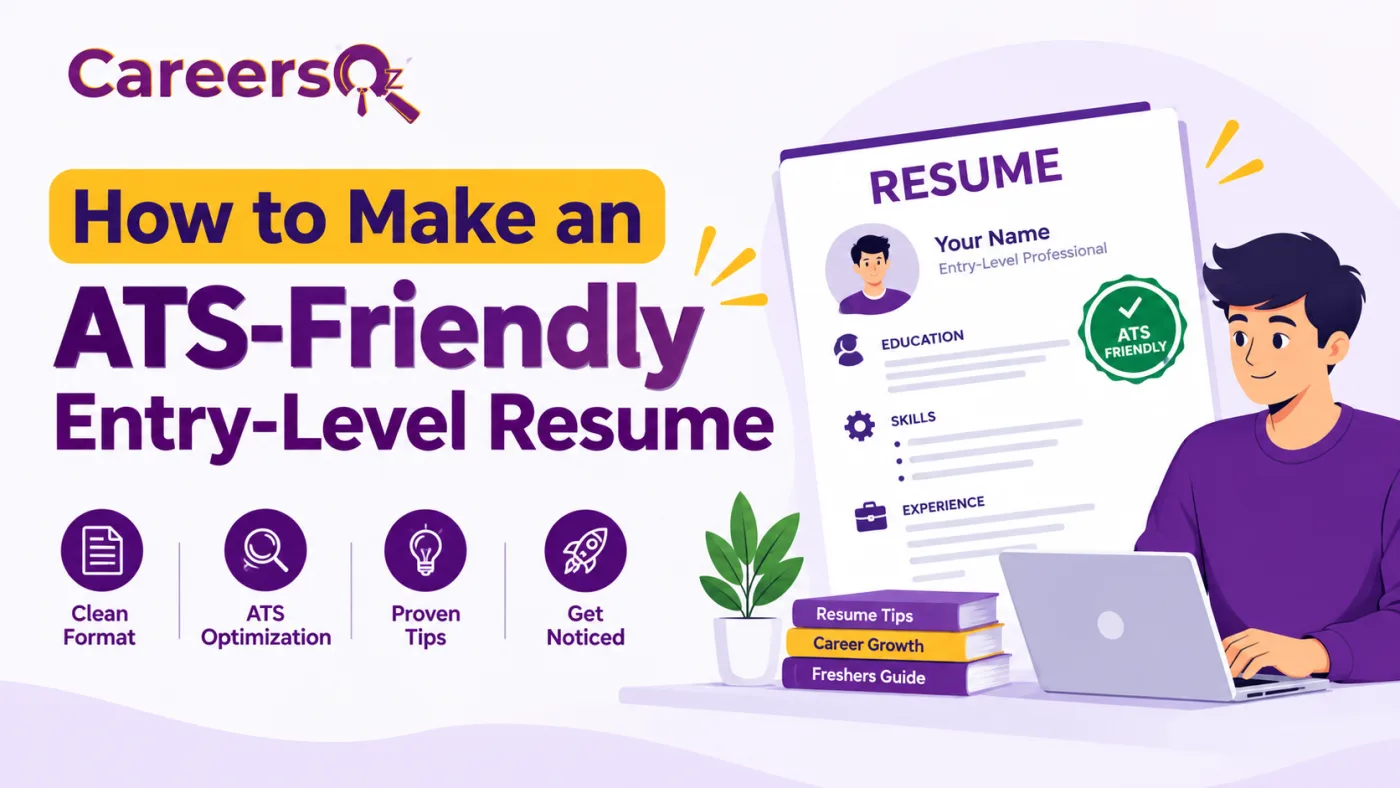
An Applicant Tracking System (ATS) is software that employers may use to help organize and screen job applications.
An ATS-friendly resume is primarily about making your information clear, readable, and relevant.
1. Read the Job Description
Before submitting your resume, identify:
- Required skills
- Preferred skills
- Job responsibilities
- Software/tools
- Qualifications
- Industry terminology
2. Match Relevant Keywords
Suppose a job description asks for:
"Google Analytics, SEO, keyword research and content optimization."
If you genuinely have these skills, use the relevant terms naturally in your resume.
For example:
Skills
- SEO
- Keyword Research
- Google Analytics
- Content Optimization
Do not add a keyword simply because it appears in the job description if you do not actually have the skill.
3. Avoid Keyword Stuffing
ATS optimization does not mean repeating the same keyword 20 times.
Keep your resume natural and readable.
4. Use Clear Section Headings
Use familiar headings such as:
- Summary
- Education
- Experience
- Skills
- Projects
- Certifications
5. Keep the Design Simple
Avoid excessive graphics, decorative elements, complicated layouts, or information that could make the document difficult to parse.
A simple resume can still look professional.
How to Customize an Entry-Level Resume for Every Job
Sending the same resume to every employer is often less effective than tailoring it to the position.
Use this process:
Step 1: Read the Job Description
Highlight the skills and responsibilities that genuinely match your background.
Step 2: Identify Your Evidence
Find examples from:
- University
- Internships
- Projects
- Certifications
- Freelance work
- Volunteer work
Step 3: Adjust Your Summary
Mention the role and relevant strengths.
Step 4: Reorder Relevant Skills
Put the most relevant skills where they are easy to find.
Step 5: Modify Project Descriptions
Emphasize project tasks related to the position.
Step 6: Proofread
Check names, dates, spelling, formatting, email address, and links.
How to Write Strong Resume Bullet Points
Avoid vague statements.
Weak
Responsible for social media.
Better
Created and scheduled social media content for a university marketing project.
Weak
Worked on a website.
Better
Developed a responsive university project website using HTML, CSS, and JavaScript.
Simple Formula
You can use:
Action + Task + Tool/Skill + Result
For example:
Analyzed website keywords using SEO tools and organized target terms into topic groups for a content project.
Only include measurable results when you have real evidence.
Never invent percentages, revenue figures, rankings, client numbers, or performance improvements.
What Skills Should Freshers Put on a Resume?
Your skills should match the job rather than simply listing everything you have ever learned.
Technical Skills
Depending on your field:
- Python
- Java
- JavaScript
- SQL
- Microsoft Excel
- WordPress
- SEO
- Google Analytics
- AutoCAD
- Data Analysis
- Graphic Design
Soft Skills
Relevant examples include:
- Communication
- Teamwork
- Problem-solving
- Time management
- Presentation
- Research
- Organization
The strongest resumes don't simply claim soft skills. They provide evidence of them through projects, activities, internships, or achievements.
For example, instead of only writing:
Leadership
you could demonstrate leadership through:
Led a five-member university project team and coordinated weekly project tasks.
What Should Freshers NOT Put on a Resume?
Not every piece of personal information belongs on a job resume.
Avoid adding information just to fill space.
Depending on the employer and application requirements, be cautious about including:
- Unrelated hobbies
- Generic statements
- Fake skills
- Fake experience
- Unverified achievements
- Excessive personal information
- Long paragraphs
- Unnecessary references
- Irrelevant certifications
- Salary expectations unless requested
What About a Photo?
There is no universal rule that every entry-level resume must contain a photo.
Follow the employer's instructions and the conventions of the specific application. For applications where a photograph is not requested, a professional resume can generally communicate qualifications without one.
Should You Include Your GPA or Marks?
If your academic performance is strong and relevant, including it may strengthen your application.
If your academic results are not a strong selling point, you may choose to leave them out unless the employer specifically requests them.
Always follow the job advertisement or application requirements.
How Long Should an Entry-Level Resume Be?
For many freshers, one page is a practical starting point.
The objective is not to fill a second page with unrelated information.
A one-page resume can contain:
- Contact information
- Summary/objective
- Education
- Skills
- Projects
- Internship
- Certifications
If you genuinely have enough relevant information to justify additional length, the document can be longer. Relevance matters more than hitting an arbitrary page count.
Entry-Level Resume Formatting Tips
Use formatting that makes the document easy to scan.
Recommended principles
- Use clear section headings.
- Keep spacing consistent.
- Use readable fonts.
- Keep bullet points concise.
- Maintain consistent date formatting.
- Use a professional email address.
- Check hyperlinks.
- Export to the requested file format.
- Follow employer instructions about file type.
Resume File Name
Instead of:
resume-final-new-updated-2.pdf
use something clear such as:
Muhammad_Ahmed_Resume.pdf
Common Entry-Level Resume Mistakes
1. Using the Same Resume Everywhere
A generic resume may not highlight the qualifications most relevant to each position.
2. Writing a Long Career Objective
Your introduction should quickly explain your relevant background and target.
3. Listing Skills Without Evidence
If possible, demonstrate skills through projects, internships, certifications, or achievements.
4. Including Fake Experience
Never invent employment, clients, certifications, results, or responsibilities.
5. Overdesigning the Resume
A complicated design can distract from the information employers need.
6. Keyword Stuffing
Use relevant job-description terminology naturally.
7. Ignoring Academic Projects
For students and fresh graduates, relevant projects can provide useful evidence of practical ability.
8. Writing Huge Paragraphs
Use concise bullet points where appropriate.
9. Including Every Certificate
Relevance matters more than quantity.
10. Not Proofreading
A spelling mistake in your name, email address, degree, or company name can create an avoidable problem.
Entry-Level Resume Checklist
Before submitting your resume, check each item:
Contact Information
- Name is correct
- Phone number is correct
- Email is professional
- LinkedIn link works
- Portfolio/GitHub link works
Content
- Target role is clear
- Education is included
- Relevant skills are listed
- Projects are relevant
- Internships are included when applicable
- Certifications are relevant
- Achievements are accurate
ATS and Formatting
- Relevant keywords appear naturally
- Section headings are clear
- Formatting is consistent
- Resume is easy to scan
- No unnecessary graphics
- File name is professional
Accuracy
- No fake information
- Dates are accurate
- Grammar is checked
- Spelling is checked
- Job description has been reviewed again
Can AI help me create an entry-level resume?
AI can help brainstorm, organize, proofread, or tailor your resume. If you want to build ATS friendly resume you can use CareersOZ CV Maker. However, you should verify every statement and ensure the final document accurately represents your real education, skills, projects, and experience. Never allow AI to invent qualifications or achievements.
Key Takeaways
- An entry-level resume is designed for students, freshers, recent graduates, and candidates with limited professional experience.
- You can create a strong resume even without full-time work experience.
- Education, internships, academic projects, certifications, skills, volunteer work, and relevant activities can provide valuable evidence.
- Tailor your resume to each job description.
- Use relevant keywords naturally rather than stuffing them into the document.
- Keep formatting simple, consistent, and easy to scan.
- Never fabricate experience, achievements, certifications, or results.
- For many freshers, a concise one-page resume is a practical starting point.
Conclusion
A lack of professional experience does not mean you have nothing valuable to show an employer. The purpose of an entry-level resume is to connect your education, skills, projects, internships, certifications, and other relevant experiences with the requirements of the job.
Start with a clear structure, focus on evidence rather than generic claims, tailor the resume to each position, and remove anything that does not strengthen your application.
Once your resume is ready, the next step is to use it strategically: apply for relevant entry-level jobs, internships, and graduate opportunities rather than sending the same application everywhere.
If you need help creating your CV, use the relevant [CareersOZ CV Maker](hthttps://careersoz.com/cv-maker tps://) or continue exploring CareersOZ's job and career resources.
About this guide: written and reviewed under our Editorial Policy and Fact-Checking Policy. Found a mistake? See the Corrections Policy. Where AI assisted, the guide says so (AI Disclosure).
Frequently Asked Questions
What is the best resume format for entry-level jobs? +
For many freshers, a simple reverse-chronological or combination format works well. Choose the format that makes your strongest relevant evidence easiest to find.
How do I make an entry-level resume with no experience? +
Focus on education, relevant skills, academic projects, internships, certifications, volunteer work, freelance work, leadership, and other evidence related to the job. You do not need to invent professional experience.
Should freshers include internships on their resumes? +
Yes, relevant internships can be valuable because they demonstrate exposure to a professional environment. Describe your actual responsibilities and contributions rather than simply listing the internship title.
Can I include university projects on my resume? +
Yes. Relevant academic projects can demonstrate technical, analytical, research, communication, or teamwork skills, particularly when you have limited professional experience.
Should I use a resume objective or summary? +
Either can work. An objective can be useful when you are clearly entering a career field, while a summary can be useful when you already have relevant internships, projects, certifications, or other experience to summarize.
How many pages should a fresher resume be? +
One page is a practical starting point for many entry-level candidates. The priority should be relevant information rather than adding content simply to increase the length.
What skills should I put on a fresher resume? +
Choose skills that are relevant to the target job and that you genuinely possess. Include technical skills where applicable and support important skills with projects, internships, coursework, certifications, or other evidence.
Is an ATS-friendly resume necessary? +
If an employer uses an applicant tracking system, clear formatting and relevant job-specific keywords can help your information remain easy to process. ATS optimization should not mean keyword stuffing.
Should a Pakistani fresher use "CV" or "resume"? +
Follow the terminology used in the job advertisement. For many private-sector positions, a concise resume is appropriate. Academic applications may require a more detailed CV.
Should freshers add a photo to their resume? +
Not automatically. Follow the employer's instructions and the requirements of the specific application. If a photo is not requested, it is not necessary simply because you are a fresher.
Should I include references? +
Usually, you do not need to use valuable resume space for references unless the employer specifically requests them.
Related guides
SBP Pasban Remittance Reward Scheme 2026: Eligibility, Prizes and What You Actually Need to Do
Quick answer: The SBP Pasban Remittance Reward Scheme is a bank-funded prize draw for people in Pakistan who receive home remittances through bank accounts. From 1 October 2026, accounts receiving at...
8 min read · 13 Oct 2026
Pakistan Startup Fund 2026: Unlock Exciting $1M Startup Funding
Quick answer: Often searched as the Prime Minister Pakistan Startup Fund, the Pakistan Startup Fund (PSF) is a government-backed, non-equity grant programme run by Ignite under the Ministry of IT &...
11 min read · 12 Oct 2026
Prime Minister SPARK & ELEVATE Program 2026: اہلیت، گرانٹس اور درخواست دینے کا طریقہ
Quick Answer The Prime Minister’s SPARK and ELEVATE Program is Ignite–National Technology Fund’s research and innovation grant. SPARK funds early-stage idea-to-prototype research up to Rs. 100 million...
17 min read · 12 Oct 2026
Housing Finance Pakistan 2026: Easy Way to Your Dream Home
Quick answer: Housing finance in Pakistan means a bank, microfinance bank or HBFCL loan to buy, build or extend a home. Under the government's Wazir-e-Azam Apna Ghar Program (formerly Mera Ghar Mera A...
15 min read · 10 Oct 2026